7th District Congressional Primary Battles – Both sides!
Initially I wrote this article back in Feb and it was really to feature Niina Baum, one of the Republican candidates in the crowded primary race in this solid Republican district. There has been some movement in the candidates, but the primary field is crowded on both sides and this is my take on the situation so far:
Will this dog sled musher prove to be the underdog and win the primary battle for the 7th Congressional District Race on August 11th 2026?
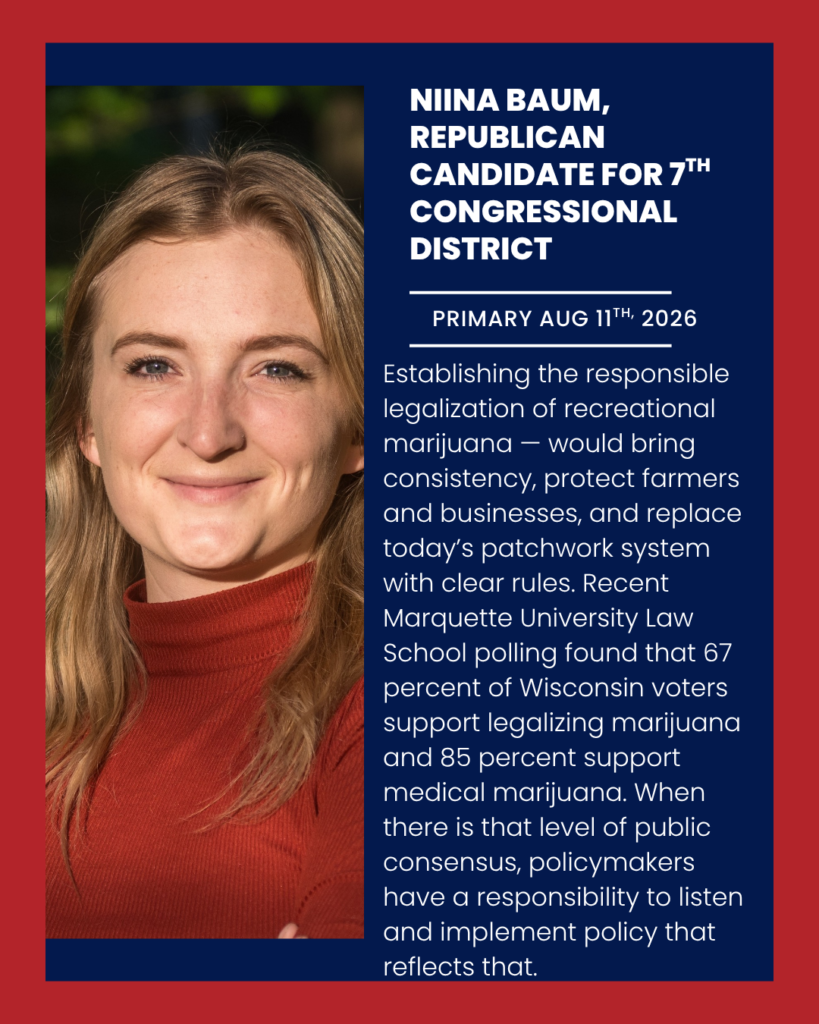
Niina Baum is a Republican Candidate in the 7th Congressional District that was formerly represented by Congressman Tom Tiffany. Nina is from Rhinelander (home of Assembly Rep Rob. Swearingen/Author of AB 606). The 7th Congressional District is a safe GOP seat and the congressional district race primary for the Republican slot is crowded, so what makes Nina Baum stand out from the rest? Her public stance on cannabis reform that was exclusively released to me for the 2026 Election Coverage Project, that is what!
This is her “cannabis statement” she provided me in Feb 2026:
“The rapid growth of intoxicating THC products derived from hemp has created confusion for consumers, businesses, and enforcement across Wisconsin, while many hemp farmers who followed federal legalization in 2018 now face growing uncertainty. Establishing the responsible legalization of recreational marijuana — would bring consistency, protect farmers and businesses, and replace today’s patchwork system with clear rules. Recent Marquette University Law School polling found that 67 percent of Wisconsin voters support legalizing marijuana and 85 percent support medical marijuana. When there is that level of public consensus, policymakers have a responsibility to listen and implement policy that reflects that.”
You can learn more about the campaign of Baum for Congress at her Official Campaign Website, Official Campaign Facebook page and Official Campaign Instagram Account.
Where is the 7th Congressional District
Wisconsin’s 7th congressional district is a congressional district of the United States House of Representatives in northwestern and central Wisconsin; it is the largest congressional district in the state geographically, covering 20 counties (in whole or part), for a total of 18,787 sq mi. The district contains the following counties: Ashland, Barron, Bayfield, Burnett, Chippewa (partial), Clark, Douglas, Florence, Forest, Iron, Jackson (partial), Juneau (partial), Langlade, Lincoln, Marathon, Monroe (partial), Oneida, Polk, Price, Rusk, St. Croix, Sawyer, Taylor, Vilas, Washburn, and Wood (partial).
What about the other Republican candidates?
During the 7th Congressional District Republican debate held on April 22nd held in Mercer by the Iron County Republican Party the candidates were asked about cannabis reform it is reported that Nina Baum was the standout in the crowd and basically reinforced her statement above while the other candidates (Jessi Ebben and Kevin Hermening) failed to support hemp cannabis reform. The Trump endorsed son in law of Secretary of Transportation and former Congressman Sean Duffy is apparently “not doing” debates according Republican social media influencers. Technically, the only candidates that we do not know their stance on hemp cannabis reform is Michael Alfonso and the late comer to the primary table Republican Don Raihala.
What about the Democrats?
Fred Clark
Well, that is Fred Clark. As a former an assembly representative he eventually “came around” to support cannabis reform measures, but he holds a place in my heart for being a non-supportive Democrat while I have been an activist.
Fred Clark was an assembly representative from 2009 until 2015. I started my activism at this time. In 2009, I am going to be hard on Clark for a minute, he sucked! He ran in a recall election against Senator Luther Olsen and during a forum when asked about hemp he took the time instead to talk about his opposition to marijuana reform. This was in 2011, way before the hemp bill and well, I felt betrayed. Technically Luther Olsen sucked during the debate also, stating his opposition to reform despite meeting with us many times, telling us at a Dec 2010 meeting he would not actively oppose legislation and vote YES should a bill come across his desk.
Fred Clark did make up for some of the crap he said and before leaving office in 2014. I believe he has one of the first co-sponsors of Mellissa Agard (Sargent) bill to legalize marijuana in Wisconsin. We are eagerly waiting to see what he promises to do on the federal end.
This instance often reminds me of the old saying, “How can you tell when a politician is lying?” Their lips move. So this campaign season, really get to know your candidates and have multiple conversations with them!
Ginger Murray
Also running is Democrat Ginger Murray, who expressed willingness to speak with industry stakeholders about hemp cannabis reform. I have not had a chance to speak with Ginger Murray yet, we keep missing each.
Chris Armstrong
Chris Armstrong has also declared his candidacy for the 7th Congressional district and immediately had this to say “Think it’s high time that cannabis be decriminalized and removed from the schedule. Our neighboring states have joined the 21st century and would like to see WI join the club.“
The call to action is simple:
If you care about cannabis reform, hemp policy, personal freedom, patient access, small business opportunities, or ending outdated laws, there is something important you should understand:
The most influential conversations in politics rarely happen during a legislative hearing.
They happen during campaigns.
With Governor Tony Evers retiring, Wisconsin is entering one of the most consequential elections in decades. New candidates are running for Governor, Congress, State Senate, State Assembly, and local offices. Many of them are still shaping their priorities, refining their positions, and deciding which issues matter most to the people they hope will elect them.
That is why your voice matters right now.
Political consultants, campaign managers, and elected officials consistently point to conversations with voters as one of the most important ways candidates learn about issues they may not have previously understood. While lobbyists, organizations, and interest groups all play a role, candidates frequently credit personal conversations with constituents for opening their eyes to new perspectives and helping them better understand how public policy affects real people.
Research has found that direct, personal contact remains one of the most meaningful forms of political communication. Candidates learn more from authentic conversations with voters than they do from reading talking points, advertisements, or social media posts. When voters engage directly with candidates, they help shape priorities and put issues on the radar before anyone takes office.
Think about it this way:
Most people complain about politics.
Very few people actually participate.
An even smaller number take the time to contact candidates, attend campaign events, ask questions, volunteer, or start a relationship with the people who may soon represent them.
That means your voice carries more weight than you may realize.
Candidates expect to hear from donors, party insiders, and political professionals. They hear far less often from ordinary citizens who simply care enough to reach out. When someone takes the initiative to call, email, attend an event, or introduce themselves, candidates notice. They remember. Relationships begin.
Today’s candidate could be tomorrow’s governor, legislator, county supervisor, mayor, or member of Congress.
The people who build relationships now often become the people whose calls get returned later.
This election cycle gives Wisconsin’s cannabis community a unique opportunity to help shape the conversation before policy positions become entrenched. If candidates hear from enough informed voters about sensible cannabis reform, patient access, hemp regulation, public safety, economic opportunity, and personal freedom, those issues become harder to ignore.
To help start those conversations, the Wisconsin Cannabis Activist Network has assembled a collection of candidate resources, educational materials, legislative background information, and policy guides that you can share with candidates and campaigns.
Feel free to use our materials, share your own experiences, or do both. Your personal story and perspective may be the conversation that helps a candidate better understand why cannabis reform matters to Wisconsin voters.
We also invite you to continue the conversation on our new 2026 Election Coverage Forum, where activists, advocates, candidates, and voters can discuss races, share updates, and help shape Wisconsin’s future, the dedicated thread on Wisconsin Cannabinoid Industry Council forum. Join us and continue the conversation on the new forum!
The campaign trail is where future policy begins.
Don’t wait for a bill to be introduced. Don’t wait for a hearing to be scheduled. Don’t wait until after Election Day and wonder why your issue wasn’t a priority.
Get involved now, while candidates are listening.
And if you’re not sure where to start, need help finding candidates to contact, want advice on what to say, or simply want someone to talk with before taking that first step, reach out to us. That’s why we’re here.
As mentioned above, I have some done some pre-work with these candidates and have asked them to complete the 2026 Candidate Questionnaire and will report back as the race develops! Now it is your turn to turn up the high activity directly in district!
Stay tuned and get active!
I will continue to provide you additional 2026 Wisconsin State Election coverage throughout the campaign season. This next election is extremely important for cannabis reform and I will continue to bring you information as more candidates make their political moves.
In the event that we end up with divided government in the 2027-28 legislation session, the official formation of The Wisconsin Cannabis Caucus would be a must first step towards reform. The official establishment of this Caucus will represent the growing, bipartisan support in Wisconsin.
Although session has ended for 2025-26 we still urge you to contact your elected officials, as they technically can continue to work, hold committee hearings and potentially vote on any issue that is deemed to be a great priority to Wisconsinites. The top action alerts are still functionable on The Wisconsin Cannabis Activist Action Network for you immediate use.
A huge thank you once again to all my Election Coverage Sponsors, please support them if you can. One easy way to find them all and where they are throughout our great state of Wisconsin is to use The Stoner’s Travel Guide to Wisconsin website map and tag system, here you go, check them all out: https://thestonerstravelguide.com/places/tags/2026-election-coverage-sponsor/